
Tag Archives: MDM
MDM

The Good lawsuit

Sometimes I rant about how much I hate Airwatch, they hire kids that are 21 or 22 years old, they under pay their employees, they put features in the product just to check something off for the Gartner report. ( I still feel that way sometimes) However, this is a really weak lawsuit. I dislike when technology companies attempt to patten an idea. That is basically what Good is trying to do here.
Nowhere in any of Airwatche’s code will you find anything, that even remotely resembles Good code. Good is suing over the belief that Airwatch (and Mobile Iron for that matter) stole the idea from them (and did it better then they did). This is such a ridiculous concept in technology and all it does is hurt innovation. I don’t care if Good thought up this MDM game 10 years ago, Androids and iPhones didn’t even exist back then. There is no argument for attempting to say that your patten, that applied to some old WinMO devices and Symbian devices, is valid today in the technology diverse systems that we are working in. Just think about this for a second, if this nonsensical patten crap existed 100 years ago, people would of been afraid to invent anything.
SaaS versus On-Premise solutions

So recently I had my galbladder out, so I didn’t have as much time to write, or work for that matter. I came back to my job to see that I had close to 4000 emails. Err… I can assure you that this is a very fun process of going through e-mails…or not. What I wanted to talk about today is what most people in the MDM space have seen happening over the past few years. When setting up MDM/ or any application or service that can go in the cloud, you are going to have to deal with a decision. Do we want it behind our firewall, or do you want it out in the cloud. Do we want it here, or do we want to use a SaaS (Software as a service) or a connector to get to that machine. I am going to attempt to explain the differences here. Now Obviously I assume you are going to have a whole team of network engineers, software engineers and really smart people who have put much more thought into this then you, this is just some basics.
On-Premise
The general concept behind on-premise is that you want to have control of the system. You want to be able to patch it, you want to have it on your hardware, you do not want someone to have control over its SLA’s (service delivery times) In other words You want to control the success of it.
Hosted/SaaS/Cloud
In this situation, you use some sort of VPN or connector to connect your corporate environment out to a cloud solution. In this case, you are saying that you do not want to have to deal with patching this, dealing with its up time, the only part of the equation that you are responsible for is the connection via the VPN or SaaS.
Where does MDM start and TEM end?
I’ve been working on trying to explain where mobile device management starts, and how companies use this service. I figured this was a worthy blog topic, as it is something that until recently I got wrong.
First let me show this art picture I just made that will help clarify how I break down typical MDM/TEM
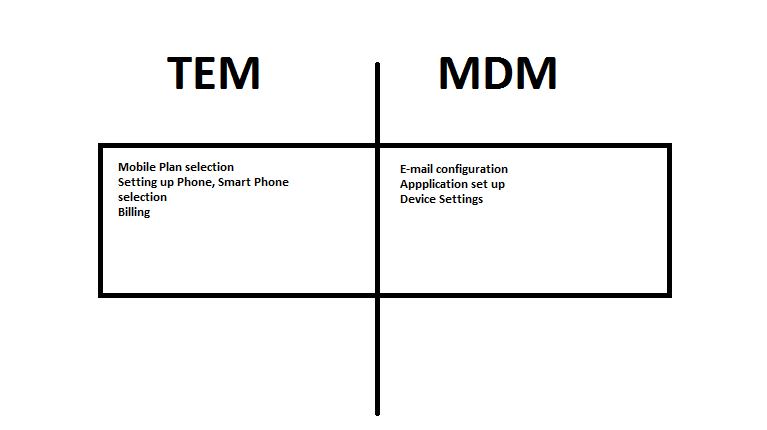
TEM stands for telecom expense management, this is the process in which you provision the phone. This is when you set up data, voice, make a phone selection (Android/BlackBerry/IPhone etc:) Now some companies can handle this entire process, you basically let them pay the bill for you, and they will handle the entire procurement for you. But that is when MDM ( in the traditional sense) begins. MDM manages the user experience when they have the phone. It is responsible for helping the user set up e-mail, get applications, set up security policies and monitor the device. The advantage to having someone to both TEM and MDM is they can manage the entire life-cycle. Customers are going to want someone who can make the entire point to point solution, they don’t want to have to deal with TEM people, or MDM people, they want to deal with mobility people. I think once we figure out that piece of the puzzle, one company who can truly do it both, they will own the entire market. Although some companies do this now, they are not known enough for it, and they do not do it on a constant enough basis.
Google announces partnership with SAP for Fiori

“We’re announcing a new relationship between SAP and Google, to help our products provide beautiful experiences to our users and to make our platforms work better for our developers,” said Singh at SAP’s Sapphire conference in Orlando this week. Google is pushing the enterprise level application market hard, and this is just the next step in what it see’s as the evolution on Android enterprise solutions. With BlackBerry 10 being the standard for HTML 5 applications right now, although not being picked up by…well anyone, it is interesting to see a huge player like Google set up a platform for HTML 5 development.
“SAP Fiori is a beautiful HTML5 platform to use to build apps from the ground up around users’ experiences that are optimized for Chrome. Chrome is the most secure, fast and modern browser on the internet,” he said. “As a consumer enterprise company we’ve found a great partner in SAP to bring the same kind of simplicity and beauty you have in the consumer world to applications for things like supply chain, finance and retail.”
Hey Apple,
What you got in store for us for HTML5?
Where have all the MDM providers gone?
Looking at BlackBerry world news, I stumbled upon an interesting fact. The sponsor list strangely had something missing. This is an impressive list of sponsors, but once you drill down into the list, what is missing…
Where are all the MDM providers? It seems that the only companies on this list that are MDM providers are Boxtone and Vox Mobile. Those two companies are more BlackBerry centric then the others. Now some companies have an MDM solution, like SAP, but they are hardly there for the MDM part of the business. This leads me to one conclusion.
Either RIM told Mobile Iron, Airwatch, Zenprise and Tangoe MDM to stay away or those companies decided that they did not need to be seen at BlackBerry live. Each of these scenario’s provides insight into what is going on in the battle for MDM. The Gardner report on MDM is due soon, and we are going to see what has happen since last year’s report put Airwatch and MobileIron on top of the pile.
Could BlackBerry be turning the page?

I was reading up on BlackBerry live news this morning and I stumbled upon this important tidbit. BlackBerry set sales records in the UK and in Canada when it launched. Now assuming this is true, this is really good news for RIM. As I wrote earlier, RIM is definitely hurting in the marketplace right now, and any good news helps. This time last year at BlackBerry world, I met with some very high profile customers who were talking about plans to move off of BlackBerry and BES. In the past few months, I’ve heard plans of implementing BES 10 ( which is the sudo-BES for BlackBerry 10 devices) along with their stand alone MDM solution
Could BlackBerry be part of MDM solutions going forward, we will see…
Citrix and Zenprise
I’ve had the pleasure of speaking to the team over at Zenprise a couple of times at BlackBerry world (formerly WES) a few years ago, and I was very impressed with their product. Recently, Citrix bought Zenprise. The obvious reason that Citrix is doing this is to get into the MDM game, in technology cash is king usually and Citrix just decided it wants to become a player. I am curious as to why they didn’t buy MobileIron or Airwatch, maybe the asking price was too much. I’ve always though Zenprise was feature rich, but behind the big two. We’ll have to wait to see how this plays out. I think one of the reasons that the MDM market is going to become saturated very quickly, is because it is incredibility painful to move off an MDM solution. Think about it for a moment, let’s say your doing an email migration from Domino to Exchange, you at least have control over the software on the computer’s your moving to. In MDM, you have to remove applications from sometimes several hundred devices, re-enroll Iphones, Androids and reconfigure connections to the BlackBerry servers. Never mind the hundreds of hours it takes to work with all your users. The lesson here, Be very sure you choose the correct MDM vendor
Mobile Iron
It seems to me that everyone is talking about Mobile Iron these days, they seem to be quickly becoming a defacto standard of MDM. I wonder when someone is going to buy them up. I can’t see someone like Zenprise being bought up, and someone like Mobile Iron being allowed to lead the market from the Back
 Peters ramblings