After years of looking exactly the same, this blog finally got a fresh coat of paint. I’ve switched things over to a darker look: black background, light text, and a more code‑friendly feel that matches how I actually spend my time these days. If you’re reading this at night or in a dim room, it should be a little easier on the eyes than the old blinding white theme I set up years ago and never touched again. Behind the scenes, I also moved the site off WordPress.com and over to a local provider. That gives me more control over backups, themes, and customization, and lets me treat this blog a bit more like the rest of my projects instead of something I only poke at every few years .Nothing dramatic is changing about the content, but the plumbing and paint are finally caught up with the present. If something looks weird or broken in the new setup, feel free to let me know—and thanks for still stopping by after all this time.

An Open Question to Microsoft: Let Me Get This Straight…

Let’s rewind the tape for a second.

It’s March 2020. The world screeches to a halt. Offices empty out. A grand, unplanned, global experiment in remote work begins. We were told to make it work, and we did. We cobbled together home offices on kitchen tables, mastered the mute button, and learned that “I’m not a cat” is a valid legal defense.

And you know who thrived in this chaos? You, Microsoft.

While the world adapted, you didn’t just survive; you absolutely exploded. Your products became the very bedrock of this new, distributed world.

Teams became the digital office, the school, the family meeting space.
Azure became the beating heart of the cloud infrastructure that kept everything running.
Windows and Office 365 were the essential tools on every single one of those kitchen-table workstations.

And the market noticed. Let’s talk about the report card, because it’s staggering:

  • 2021: You hit $2 trillion in market cap for the first time.
  • 2023: You became only the second company in history to reach a $3 trillion valuation.
  • You’ve posted record-breaking profits, quarter after quarter after quarter, for four consecutive years.

Your stock price tripled. Your revenue soared. You, Microsoft, became the poster child for how a tech giant could not only weather the pandemic but emerge stronger, more valuable, and more essential than ever before.

All of this was achieved by a workforce that was, by and large, not in the office.

Which brings us to today. And the recent mandate. And the question I, and surely thousands of your employees, are asking:

Let me get this straight.

After four years of the most spectacular financial performance in corporate history…
After proving, unequivocally, that your workforce is not just productive but hyper-productive from anywhere…
After leveraging your own technology to enable this very reality and reaping trillions of dollars in value from it…
After telling us that the future of work was flexible, hybrid, and digital…

You are now asking people to return to the office for a mandatory three days a week?

What, and I cannot stress this enough, the actual fuck?

Where is the logic? Is this a desperate grasp for a sense of “normalcy” that died in 2020? Is it a silent, cynical ploy to encourage “quiet quitting” and trim the workforce without having to do layoffs? Is it because you’ve sunk billions into beautiful Redmond campuses and feel the existential dread of seeing them sit half-empty?

Because it can’t be about productivity. The data is in, and the data is your own stock price. The proof is in your earnings reports. You have a four-year, multi-trillion-dollar case study that says the work got done, and then some.

It feels like a profound betrayal of the very flexibility you sold the world. It feels like you’re saying, “Our tools empower you to work from anywhere! (Except, you know, from anywhere).”

You built the infrastructure for the future of work and are now mandating the past.

So, seriously, Microsoft. What gives? Is the lesson here that even with all the evidence, all the success, all the innovation, corporate America’s default setting will always, always revert to the illusion of control that a packed office provides?

It’s not just wild. It’s a spectacular disconnect from the reality you yourself helped create. And for a company that prides itself on data-driven decisions, this one seems driven by something else entirely.
Reviewing updates for Teams

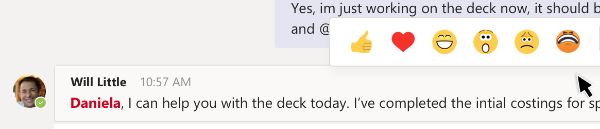
I really like the new reactions in teams.  Although, I am growing tired of the comparison to Slack.  Every time Microsoft drops a new feature in Teams, the pundits say the same thing “Slack already does that”


Well you know what slack doesn’t do?

PowerPoint, Word, Office, Email, single pane of glass work experience….but regardless


And finally from last month…..


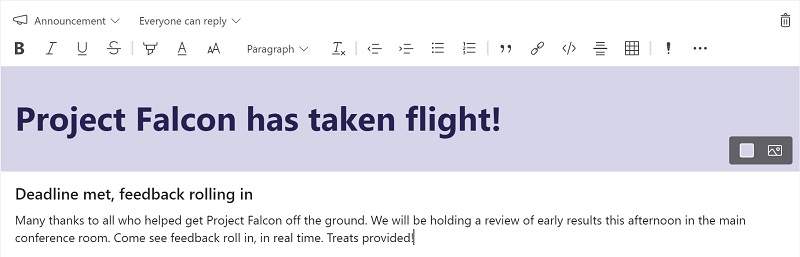
Announcements. This is actually quite a cool feature that I think this is quite a cool feature that doesn’t get nearly enough usage.

An announcement-style message in a channel

Teams to be included in all O365 Business installs

Currently, Microsoft Teams is a separate installation from Office 365 Business. But, starting in January 2019, Teams will be installed by default for new installations of Office 365 Business, starting with Version 1901.

I saw this on twitter this morning and I thought it was really interesting. I’ve written before about how I think the O365 stack wins when you put it up against other individual technologies.  It seems apparent that Microsoft see this as well.  Good stuff.

Mobile Edge Browser

edge!


I have no idea why MS keeps pushing the Edge browser, never mind pushing it on mobile device.  I admit, it is pretty fast and functional on PC.  I can’t understand the logic behind why you think making it work on a Mobile Device would be something anyone would be remotely interested in.

From Microsoft

New Microsoft Edge browser settings for Windows 10 and later


This update includes new settings to help control and manage the Microsoft Edge browser on your devices. For a list of these settings, see Device restriction for Windows 10 (and newer).


New apps support with app protection policies


You can now manage the following apps with Intune app protection policies:


  • Stream (iOS)
  • To DO (Android, iOS)
  • PowerApps (Android, iOS)
  • Flow (Android, iOS)


Use app protection policies to protect corporate data and control data transfer for these apps, like other Intune policy managed apps. Note: If Flow is not yet visible in the console, you add Flow when you create or edit and app protection policies. To do so, use the + More apps option, and then specify the App ID for Flow in the input field. For Android use com.microsoft.flow, and for iOS use com.microsoft.procsimo.


Intune GitHub

I’ve been doing more and more work lately with Intune and Powershell.  I have to tell you I am very happy with the current state of the Graph API and the MS GitHub repository.  I am getting a bunch of great stuff out of it.  So easy to use, and some great examples.

If you haven’t worked on it yet, you should check it out.

https://github.com/microsoftgraph/powershell-intune-samples

Export to 4k pro plus Version 1711

Cool feature by Microsoft, you can now export to presentations to 4k, this was released in version 1711.  Really cool, hopefully some people at the office who I know have asked about this can get some use out of this feature.

Conditional access

I have been working on conditional access rules this week in my test environment.  I am planning on trying to sell to my senior leadership a plan to move off traditional MDM and towards an Intune/MAM conditional access setup.

Some of the things I really like about conditional access is the ability to control all of the different client access.  I can lock it down to could application type, or domain user etc:

The only real problem I’ve come across is trying to sell this. It is such a huge change, and really requires all or nothing type approach.  We will see what the new year brings.