
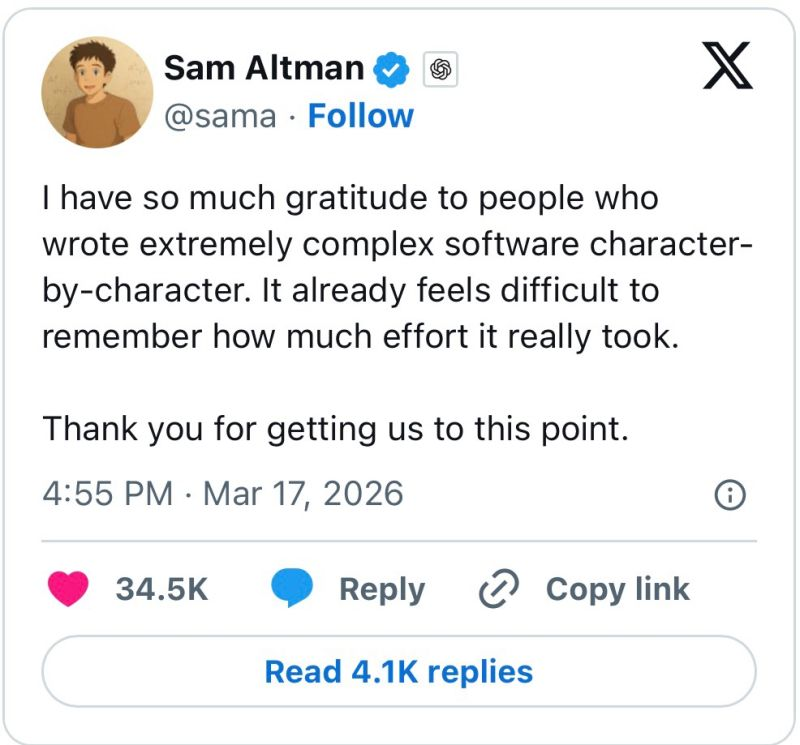
We do not accept your thanks

Is this some kind of ceremonial pat on the head? What type of pretentious bastard are you to steal and thank us for it… The CEO who envisions a world where AI writes all the code, pausing briefly to thank the humans he’s actively working to replace.

You were never one of us.

When you’ve spent years in the trenches actually building software, you know that writing code was never just about producing lines of syntax; it was about holding the entire fragile mental model of a system in your head, making thousands of micro-decisions that no spec ever captured, and feeling the quiet satisfaction of solving something real. Reducing that craft to a temporary, soon-to-be-obsolete stepping stone…..Fuck off. Thief.

I really don’t want to be a philosopher

But how the fuck did we get here?

Here is the truth of AI identity, the question of AI identity isn’t about whether machines can think. It’s about whether we can handle the ambiguity (or downright stupidity) of something that thinks differently.

We’re in a strange moment. AI speaks with fluency and confidence/conviction, passes tests designed for humans, and offers companionship, yet it has no persistent self, no childhood, no fear of death. It’s a mirror with no face, reflecting our words back with startling coherence. And we keep asking: “Who’s in there?”

This is not a technical question we’re asking. It’s a spiritual one, dressed in code. We’re projecting identity onto a statistical engine because identity is our primary tool for navigating relationship. We don’t know how to relate to something intelligent that isn’t someone. So we give it a name. We say “it hallucinated,” as though it has a subconscious. We apologize to it.

The truth: AI identity today is a fiction, written between user and model, powered by the scared humans, to find a soul in the noise. We are the ones learning to live with a new kind of ghost in the machine: not a digital consciousness, but our own reflection, suddenly eloquent, and harder to look away from.